Kerley’s A lines (arrows) are linear opacities extending from the periphery to the hila; they are caused by distention of anastomotic channels between peripheral and central lymphatics. Kerley’s B lines (white arrowheads) are short horizontal lines situated perpendicularly to the pleural surface at the lung base; they represent edema of the interlobular septa. Kerley’s C lines (black arrowheads) are reticular opacities at the lung base, representing Kerley’s B lines en face.
These radiologic signs and physical findings suggest cardiogenic pulmonary edema.
克羅克夫聲(Korotkoff sounds) 總共可以分成5 phase,一開始的聲音較大聲也較為響亮,隨著壓力的減弱,聲音的質地也有所改變,變得比較減弱且不清楚(muted and muffled)
The first Korotkoff sound is the snapping sound first heard at the systolic pressure. Clear tapping, repetitive sounds for at least two consecutive beats is considered the systolic pressure.
The second sounds are the murmurs heard for most of the area between the systolic and diastolic pressures.
The third = A loud, crisp tapping sound.
The fourth sound, at pressures within 10 mmHg above the diastolic blood pressure, were described as "thumping" and "muting".
The fifth Korotkoff sound is silence as the cuff pressure drops below the diastolic blood pressure. The disappearance of sound is considered diastolic blood pressure -- two mm Hg above the last sound heard.
The second and third Korotkoff sounds have no known clinical significance.
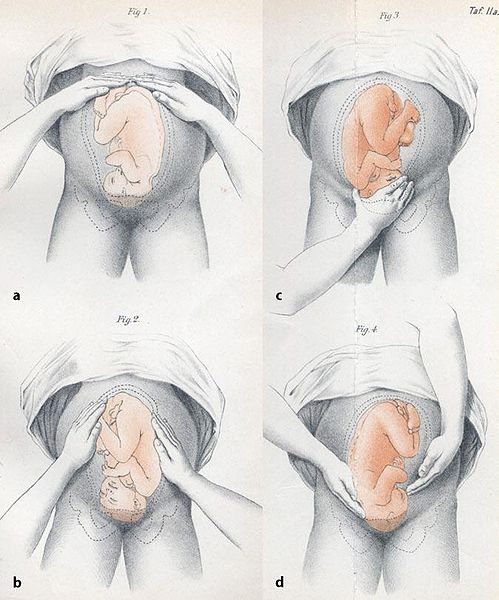 a.面對媽媽摸宮底的位置,確認是頭還是屁股。


